For $50 a month, Locally 360 gives your Oregon service business its website, quote forms with a lead inbox, booking requests on a Jobs board, and invoices your customers pay by card. It's month to month, with no minimum term.
On the $50 alone, you pick one of our designs and build your site yourself in the editor. If you'd rather have it built for you, builds are from $1,500, one time, up to 20 pages and one revision round, and you'll see your new site in about 48 hours.
In Oregon, mowing, edging and weeding need no state license. Installs, planting and irrigation repair need two licenses from the Landscape Contractors Board (LCB). Pest control, and weed or moss treatment for pay, need pesticide licenses from the Oregon Department of Agriculture (ODA), with one narrow exception for maintenance crews. Pressure washing only to clean needs no Construction Contractors Board (CCB) license. Oregon has no general sales tax.
If you hold an LCB or CCB license, Oregon rules say your website must show its number. Every Locally 360 design has a licenses and certifications section, where you write in each license, number included. Each rule below links the agency that sets it, and that agency has the final word on your own case.
Questions first? Email support@locally360.app. We reply within three business days.
Locally 360 is provided by Eveneer Solutions LLC.
Who licenses what, by trade
Four state agencies set the rules for these trades: the LCB, the CCB, ODA and the Department of Environmental Quality (DEQ). We checked each agency link on November 7, 2026.
Tree services
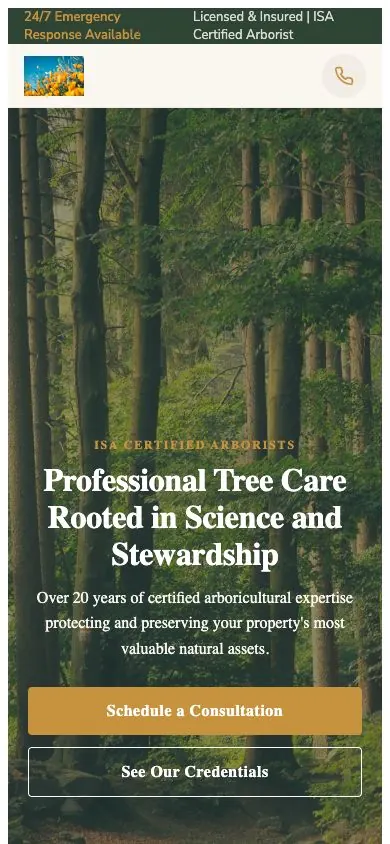
- Removal, stump grinding and limb guying: an LCB or a CCB license, says the LCB's tree FAQ.
- Planting trees: an LCB license.
- Trimming: the same FAQ says an LCB license covers all tree work, trimming included.
- The CCB lists tree servicing as work that needs a CCB license. Another LCB document says the CCB has jurisdiction over tree work. Confirm your case with both boards.
- Arborists: Oregon has no standalone state arborist license.
- Arborists certified by the International Society of Arboriculture (ISA) who pass the laws, rules and business practice part of the LCB exam can get the LCB's optional Arborist License Phase.
Lawn care and landscaping
- Mowing, edging, weeding and spreading bark dust: not regulated by the state. Your city or county may have its own license or permit rules.
- Installs, planting and irrigation repair: two LCB licenses.
- The person who passes the exams and supervises holds a Landscape Construction Professional (LCP) license.
- The company holds a Landscape Contracting Business license. It carries a $20,000 bond, or $15,000 on a probationary license, and at least $500,000 in liability coverage. A business with employees also needs workers' compensation insurance, the LCB says.
- LCB fees: $375 for the business license and $200 for the LCP license.
- Adjusting sprinkler heads and programming controllers: no license.
- A maintenance-only business may do small extra jobs for a regular customer, up to $500 in labor and materials per job site a year, but may not advertise them.
- Spraying weeds or moss for pay is pesticide work, so see pest control below.
Pest control
- The business: an ODA Commercial Pesticide Operator license.
- Each person who applies or supervises: a Commercial Pesticide Applicator license, working for a licensed operator.
- Trainees: a Pesticide Apprentice license, supervised by a licensed applicator.
- Household and structural pests: ODA's Industrial, Institution, Health and Structural (I.I.H.S.) category.
- Lawns and ornamental plants: the Ornamental and Turf category.
- Pests that may harm public health: the Public Health category.
- ODA's applicator form says the license expires on December 31 of the year it's issued.
Pressure washing
- Washing only to clean surfaces, such as siding and sidewalks: no CCB license.
- Washing that goes beyond cleaning may need a CCB license.
- Killing moss or algae on roofs and siding: pesticide work, under ODA's I.I.H.S. moss control subcategory.
- Wash water that drains to storm sewers or surface waters falls under DEQ's 1700-A permit, mobile washing included. Its current terms are unconfirmed, as noted below.
- The permit document says you may work without a DEQ permit if you collect and recycle all your wash water, or send all of it to the sanitary sewer.
- DEQ's recommended best practices, dated March 1998, say mobile washers using soap, chemicals, steam or heated water must collect wash water on site.
- Your city or county may add its own stormwater rules, so ask them too.
Every trade
- Registering your business name isn't a license, says the Secretary of State.
- Businesses register through the Business Registry at the Secretary of State's Corporation Division.
- A sole proprietor registers only when trading under a name that leaves out their own.
- A new LLC files Articles of Organization and annual reports.
- Your city or county may have its own business license rules, so ask them.
- Around Portland, Metro's regional contractor business license is honored in 20 cities for construction and landscape contractors, but not in Portland itself.
What Oregon's rules put on your website
Some of these rules reach your website directly.
Your license number. Oregon's advertising rule for landscape businesses, OAR 808-003-0010, says written advertising must include the LCB business license number. Cornell Law School's copy of the rule says a website must show it at least on the homepage, the footer or the contact page. Contracts, proposals, estimates, bids and invoices need it too. The LCB's own page says all written advertising, websites included, must carry it.
If you work under a CCB license, for tree work or washing beyond cleaning, the CCB requires its license number on advertising, websites included. Leaving it out can bring a fine of up to $400.
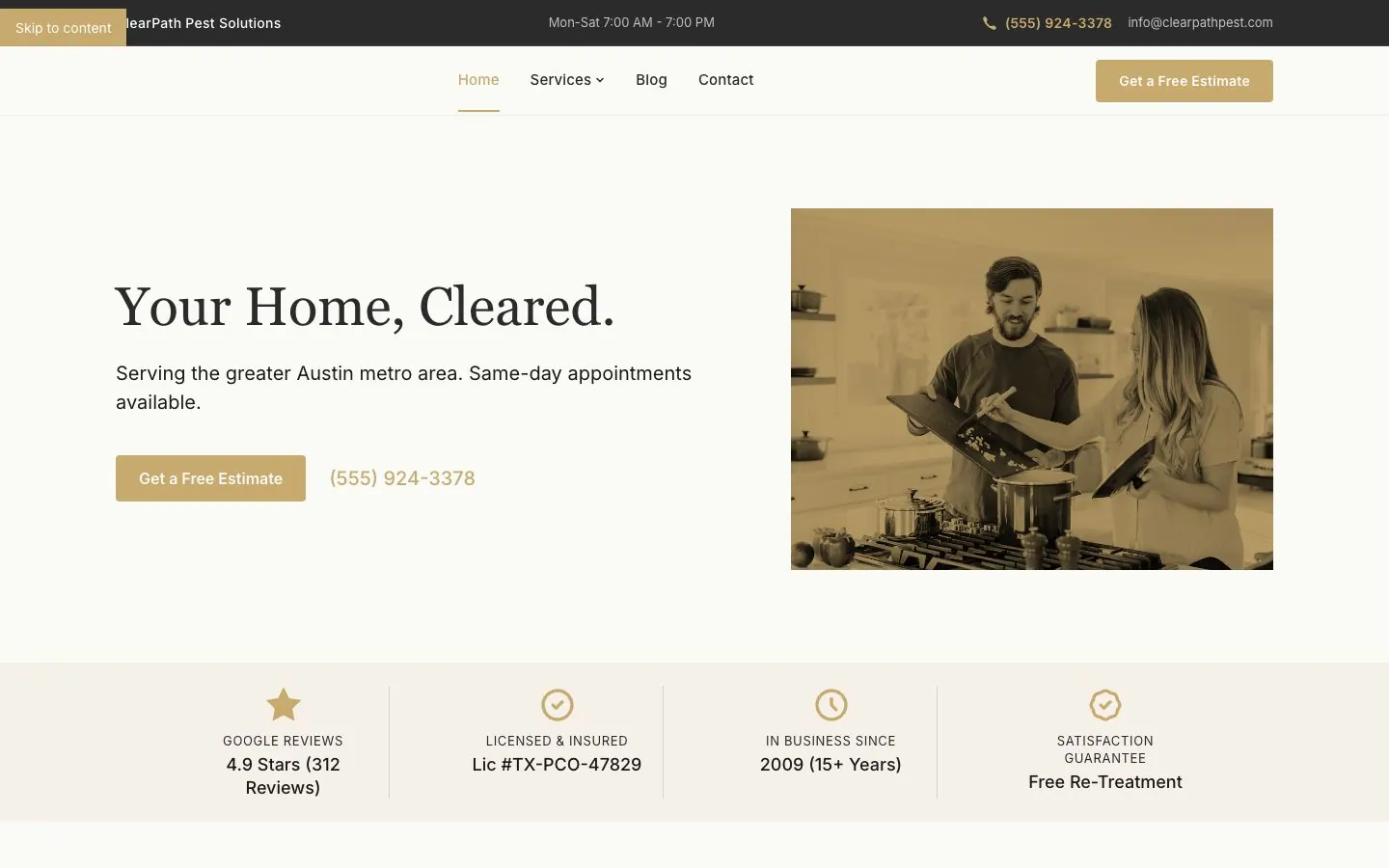
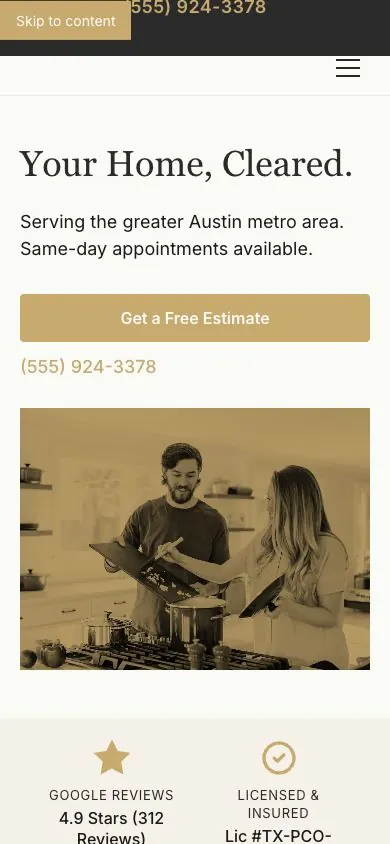
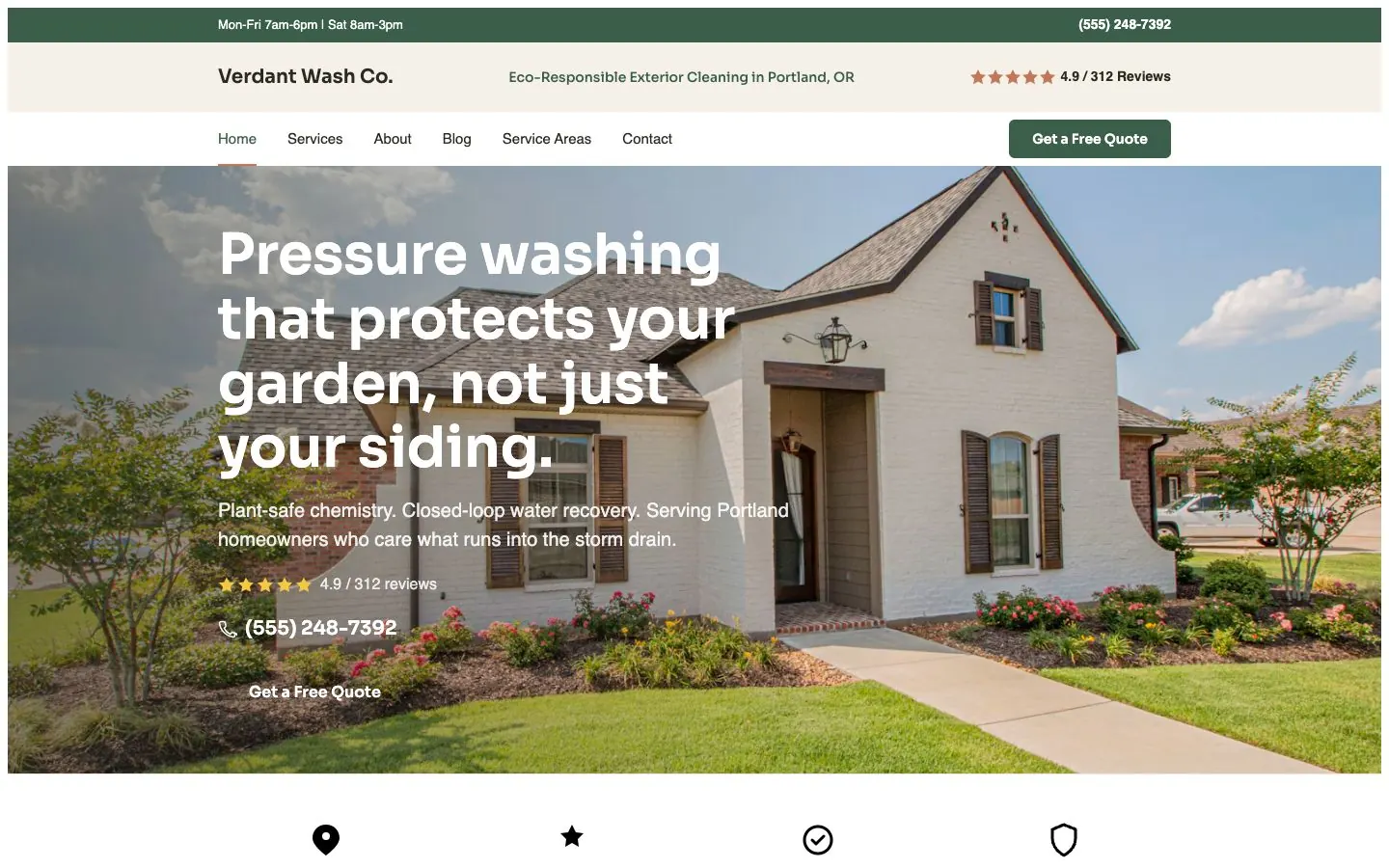
Every Locally 360 design has a licenses and certifications section, where you write each license in your own words, number included. In the editor you add, reorder and remove sections, so you can put that section on your homepage or contact page. You can also write the number into your footer or contact text. It shows only where you write it.
Pest control. List your ODA operator and applicator licenses in the same section. The rules above are the LCB's and the CCB's, so ask ODA whether it wants its license number in your ads.
What a lawn site lists. Without both LCB licenses, a business can't advertise installs, planting or irrigation repair. A maintenance-only business can't advertise its small extra jobs under the $500 cap either. So a maintenance-only site lists mowing, edging, weeding and bark dust, not installs or irrigation repair.
Weed and moss treatment. A maintenance crew may apply general use pesticides without a license only if pesticides aren't in its ads or contracts. The other conditions: small home lawns and gardens only, no restricted use pesticides, no fuel or electric-powered sprayers or spreaders, and no school campuses. If your site offers weed and feed, weed spraying or moss treatment, pesticides are in your ads. That work then needs the ODA operator and applicator licenses.
What a washer's site says. The CCB's exemption covers washing for cleaning only, so name what you clean, such as siding and sidewalks.
Where you work. Your business profile holds a service area of up to 50 cities, so you can name the Oregon towns you cover. See how to update your service area.
Every Locally 360 site is built so Google can find you. See the website and the editor.
 Rapid Grounds Edit content
Editor · Rapid Grounds
Build pages, place components, edit their content.
Pages
/
/services
/about
/contact
/about
Add pageAdd post
Landscape Contracting Business license, LCB #00000
Component to add
Quote requests and the $2,000 contract
A quote request from your site lands in your lead inbox, and each one is also emailed to you. You mark each one new, handled or archived, and you reply to the customer outside the app. Locally 360 doesn't write estimates or quotes, so the written quote is yours to prepare. See quote forms and the lead inbox.
For landscape work of $2,000 or more, the LCB requires a written contract. It must show your business name, license number, physical address, mailing address and phone number, and carry the LCB's Notice of Right to Cancel. Since September 24, 2025, every consumer, renters included, can cancel a landscape contract within 3 business days of signing.
The LCB says not to start the work or buy materials until those 3 days pass, unless the customer waived them in writing. If you buy materials early and the customer cancels, you may have to refund the deposit.
Booking requests from your site become jobs on your Jobs board. You confirm or decline each one, put a crew on it and send the crew the job's details by email. On a signed landscape contract, send the crew only after the 3-day cancel window has passed, unless the customer waived it in writing. See booking requests and the Jobs board.
Rapid Grounds Lead inboxMarch 2026: 4 inquiries
Earlier monthNora Pell
Quote form
- nora.pell@example.com
- Phone
- (555) 014-3388
- Message
- Front and back yard. Beds need edging and fresh mulch.
Theo Marsh
Contact form
Oregon sales tax, the CAT and your invoices
Oregon has no general sales or use tax, says the Department of Revenue. So a tree, lawn, pest control or washing invoice carries no state sales tax. Locally 360 invoices start with tax switched off.
The Corporate Activity Tax (CAT) isn't a sales tax. It's measured on a business's Oregon commercial activity, which means its gross receipts. Only a business with more than $1 million of taxable Oregon commercial activity owes it. A business registers within 30 days of reaching $750,000 of commercial activity in a year. The Department of Revenue says a business may include the CAT with its other costs when it sets its prices. It's a tax on the business, not a tax you add to an invoice the way a sales tax is.
In Portland, the city's 2.6% business license tax and Multnomah County's 2% business income tax are on net income, not on invoices. For tax years starting in 2026, the city exempts businesses with under $75,000 in total gross receipts, wherever earned. From 2027 the city's cutoff is $100,000. The county exempts businesses with under $100,000 in gross receipts from all business, inside and outside the county. Exempt businesses still file a return every year to claim the exemption. A business working in Portland or Multnomah County has to register for a tax account with the Revenue Division.
Landscaping jobs over the state line in Washington are different. Washington's Department of Revenue says retail sales tax is due on landscaping services, at the rate for the job's location. For any Washington job, ask that department what you need to register and charge before you add a rate. Each invoice line has a Taxable switch and its own rate, and each rate has a name, a percent and a jurisdiction. See how to add a sales tax rate.
For maintenance accounts, an invoice can repeat weekly, monthly, quarterly or yearly. Each repeat arrives as a draft for you to send. See how to send a repeating invoice. You mark cash or check payments as paid. Card payments go into your own Stripe account, at Stripe's standard pricing.
The LCB rule above lists invoices too. Your invoice page shows your business name, your address and, when you set one, a tax registration number. It has no field for a license number, but you can write your LCB or CCB number in the invoice notes, which print on the invoice under Notes.
For your own tax questions, ask the Department of Revenue. See invoices and card payments.
Rapid Grounds InvoicesInvoice INV-1042
DraftInvoice number
Your own numbering. Any format, unique on this site.
Customer name
Customer email
Issue date
Due date
Add line
Issue invoice
Changes in 2025 and 2026, and what's planned
- September 24, 2025: every consumer, renters included, can cancel a landscape contract within 3 business days.
- October 1, 2025: LCB fees rose to $375 for the business license and $200 for the individual license, from $345 and $170.
- January 1, 2026: standard landscape contracting businesses must carry a $20,000 bond, and probationary license holders a $15,000 bond.
- 2026 and 2027: Portland bans gas handheld and backpack leaf blowers from January through September. From 2028 the ban runs all year. It applies inside Portland city limits only. Property owners must make sure the crews they hire comply, and fines run $250 to $1,000 per violation.
- November 2026 to January 2027: ODA plans hearings and final rules on pesticide application records, and on supervising applicators who aren't certified. Final terms aren't out, so check with ODA.
- January 2027: ODA plans a new Laws and Safety manual and exam.
- 2027: DEQ plans to reissue the 1700-A wash water permit.
Not settled, and who to ask
- Fertilizer for hire: no ODA page we read says whether applying fertilizer alone needs a state license. ODA's fertilizer guide says Oregon businesses that mix or blend fertilizer, and businesses that distribute it in bulk in Oregon, need a Manufacturer-Bulk Distributor license. Bulk includes spreader trucks. A crew that blends its own mix or carries fertilizer loose in a spreader truck may fall under it. Ask the ODA Fertilizer Program about your work.
- Wash water permit terms: we couldn't confirm the 1700-A permit's current terms. DEQ says a permit awaiting renewal generally stays in effect if the holder applied to renew on time. Ask DEQ Water Quality whether your washing needs coverage.
- City and county taxes on services: the Department of Revenue's sales tax page mentions local taxes only on hotels and rental cars. We found no official list of city or county taxes on services. Ask your city.
- Which board covers tree work: two LCB documents disagree. One says the CCB has jurisdiction over tree work, and the LCB's tree FAQ says an LCB license covers all of it. Ask the LCB or the CCB.
What it costs
| Line | Detail |
|---|---|
| Monthly | $50 a month, the same for any team or crew size. |
| In the $50 | Hosting, security certificates and updates, the editor, quote forms and the lead inbox, booking requests and the Jobs board, crews and dispatch, invoices paid by card, a customer portal, two-factor sign-in and passkeys, a monthly report, and a site built so Google can find you. |
| Term | Month to month, with no minimum term. |
| How to cancel | Online from your billing page, or by email. It takes effect at the end of the paid period, with no refund for the rest. |
| Optional build | From $1,500 one time, up to 20 pages and one revision round. It needs the $50 a month. |
| With a build | Nothing needed from you to start. You'll see your new site in about 48 hours. |
| If the preview is late | If it takes longer than 7 days, tell us. We get 10 more days. If we still miss it, your whole build fee comes back. The monthly is separate. |
| Ordering a build later | At signup or any time after, with no extra charge for ordering later. |
| Without a build | You build the site yourself in the editor. |
| Yours | The account and the site, from day one. |
| Licensed while you subscribe | The design. It can't move to another host. |
| Domains | Every site gets its own address on locally360.app, and you can use your own domain too. Locally 360 never charges for domains or asks for registrar passwords. |
| Your data after you cancel | Within 7 days after your last paid period ends, ask by email for an export: page content, business profile, uploaded media, inquiries, and invoice, payment and booking records. |
| Price changes | 30 days' notice by email. You can cancel before the new fee applies. |
| Not included | Review management, Google Business Profile posting, social media, ads, email hosting, texting, backups, content edits done for you and domain registration. You edit your own site in the editor, any time. |
| Who can sign up | Businesses in every US state. |
See every cost on the pricing page.
Questions
Does a tree service need an LCB or a CCB license?
An LCB or a CCB license covers tree removal, stump grinding and limb guying, says the LCB's tree FAQ. Planting trees needs an LCB license. Oregon has no standalone arborist license. Two LCB documents disagree on which board covers tree work, so confirm your case with the LCB or the CCB.
Do I need a license to mow lawns in Oregon?
Mowing lawns needs no state license in Oregon. The LCB says landscape maintenance, such as mowing, edging and weeding, isn't regulated by the State of Oregon. Your city or county may have its own license or permit rules. Planting, installs and irrigation repair need two LCB licenses.
What does an Oregon landscape contractor license cost?
The LCB charges $375 for the Landscape Contracting Business license and $200 for the Landscape Construction Professional license, its fees since October 1, 2025. The business also carries a $20,000 bond, or $15,000 on a probationary license, and at least $500,000 in liability coverage.
Does pressure washing need a CCB license in Oregon?
Pressure washing only to clean surfaces, such as siding and sidewalks, needs no CCB license, says the CCB. Work beyond cleaning may need one. Killing moss or algae is pesticide work under ODA, and wash water that drains to storm sewers falls under DEQ's 1700-A permit.
Is weed and feed a pesticide in Oregon?
Yes. ODA says weed and feed and moss killers are pesticides, and that licensing is required before applying them commercially. In general, the person applying them for a customer needs a commercial applicator license, and the business needs a commercial operator license. A maintenance crew is exempt only under narrow conditions, and never when its ads or contracts mention pesticides.
Do I need a license to fertilize lawns for hire in Oregon?
No ODA page we read says whether applying plain fertilizer for hire needs a state license. Weed and feed counts as a pesticide, so applying it for hire generally needs ODA's pesticide licenses. Ask the ODA Fertilizer Program about plain fertilizer.
Do I charge sales tax on services in Oregon?
Not state sales tax. Oregon has no general sales or use tax, says the Department of Revenue. We found no official list of city or county taxes on services, so ask your city. Locally 360 invoices start with tax switched off. Landscaping jobs in Washington are different: Washington's Department of Revenue says sales tax is due on landscaping services, at the rate for the job's location.
Do I need a business license in Oregon?
Registering with the Secretary of State's Business Registry isn't a license. Your trade may still need one from the LCB, the CCB or ODA. A sole proprietor working under their own name doesn't have to register with the Business Registry. Your city or county may have its own business license rules, so ask them.
What happens to my site if I cancel?
Your site stays up until the end of the period you paid for, with no refund for the rest of it. Within 7 days after that, you can ask by email for an export of your data. Stock images and the design aren't part of the export. Locally 360 never charges for domains and never asks for your registrar passwords.
Getting started
Here's what you can count on: a site built so Google can find you, every inquiry in your lead inbox and emailed to you, and a short report each month with inquiries against last month, page views and your most viewed pages. It's month to month with no minimum term, so look at all of it and decide what's right for your business.
Questions first? Email support@locally360.app. We reply within three business days.
Designs and tools by trade: tree services, pressure washing, pest control and landscaping. Or go back to the US page.
Not tax or legal advice. For your own situation, ask the agency or an accountant.
Anything else, email support@locally360.app. We reply within three business days.