Locally 360 gives service businesses in New Hampshire, and in every other US state, a website and business tools for $50 a month, month to month with no minimum term. A build by us is optional, from $1,500 one time, for up to 20 pages and one revision round.
You get a site built so Google can find you, quote and contact forms with a lead inbox, and booking requests that become jobs. You also get itemized invoices your customers can pay by card, a customer portal and a monthly report.
New Hampshire's Attorney General's office says home contractors don't need a state license. Instead, it tells homeowners to get estimates and a contract in writing, to pay no deposit over half the price, and to have more ways to pay than an app transfer. Your quote form takes each request in writing, and your invoices are itemized and can't be changed once you issue them.
If your crew applies pesticides on customers' property, even store-bought weed killer, New Hampshire does ask for a license: a Commercial Applicator license from the Division of Pesticide Control. Every rule below names its agency. We checked each one on November 7, 2026.
Questions first? Email support@locally360.app. We reply within three business days.
What New Hampshire homeowners are told to ask for
In a March 2022 consumer alert, the Attorney General's office wrote: "In New Hampshire, contractors do not need to be licensed." The same March 2022 consumer alert tells homeowners what to look for instead.
This is the Attorney General's advice to homeowners, not a rule on your business. Under each point is what Locally 360 does.
- Written, itemized estimates and a written contract. Your quote form takes each job request in writing. Each one lands in your lead inbox and is emailed to you. Locally 360 doesn't write estimates or contracts, so you write those yourself.
- No deposit over 50%, and no full payment before the job is done. An invoice holds any lines and amounts you enter, so you can send one invoice for an agreed deposit and a second for the rest. A single invoice has no deposit or part-payment option. You decide when to issue each invoice.
- More than Zelle or Venmo as a way to pay. Customers can pay your invoices by card, into your own Stripe account, at Stripe's standard pricing. You set up a new Stripe account through Stripe's own pages. The guide to setting up card payments shows each step. For cash or check, you mark the invoice paid.
Request a quote
Name
Service
Message
Invoices on Locally 360 are itemized, and you number them your own way. Once you issue an invoice, nothing on it can be changed. You can only cancel it. The invoice email goes out under your business name, and your customer's reply comes to you. The invoice they open shows your business name and address. In the customer portal, they see their invoices and bookings in one place, with no password.
Rapid Grounds
2210 Bayview Dr
Invoice INV-1042 from Rapid Grounds. Due March 24, 2026.
Billed to
Nora Pell
The Attorney General has acted on false license claims before. In 2015, a contractor's business card claimed he was a licensed home contractor and insured, and he was neither. The office treated that as a violation of the Consumer Protection Act. That case is in its 2015 settlement notice.
Every Locally 360 design has a licenses and certifications section, for the credentials you actually hold. You write each one in your own words, with its issuer. Add its number if you want it shown. One example is your pesticide applicator license and its category.
More on invoicing, quote forms and how to create and send an invoice.
What it costs and what's yours
- Monthly: $50 a month, the same for every owner, whatever the size of your team or crews.
- Term: month to month, no minimum term.
- Build it yourself: on the $50 alone, in the editor, on the design you choose. For landscaping and pressure washing, a setup questionnaire fills in your first pages.
- Or we build it: from $1,500, one time, up to 20 pages and one revision round. The build needs the monthly plan, but the plan doesn't need the build.
- Yours: the account and the site, from day one.
- The design: you use it while you subscribe, and it can't be moved to another host.
- Your domain: we never charge for it or ask for registrar passwords.
- To cancel: online from your billing page, or by email.
- Export: ask by email within 7 days after your site goes offline.
Locally 360 is provided by Eveneer Solutions LLC. See every cost.
The pesticide license New Hampshire does ask for
Applying pesticides on anyone else's property in New Hampshire needs a Commercial Applicator license from the Division of Pesticide Control. That includes store-bought weed and insect killers, and work you aren't paid for. UNH Extension adds that natural and organic products count too.
- Each business or branch office that applies pesticides: at least one Supervisory license holder.
- Each crew applying pesticides: at least one person with an Operational or Supervisory license.
- The business itself: registered with the Division too.
- Supervisory license: an approved experience resume, a written exam and an oral exam. A panel of three gives the oral exam.
- Fees: $60 for the license and $15 for the exam.
- Renewal: every year. If it isn't renewed by June 1, you take the exam again.
- Continuing education: credits earned over a 5-year period.
- Insurance: required. Ask the Division for the amounts.
- Categories: a license in one category doesn't cover another.
The Division's categories by trade, from its applicator categories sheet and commercial for-hire guide:
- Lawn and turf: G2 Turf Pest Control.
- Shrubs and trees: G1 Shade and Ornamental Pest Control. Tree spraying or injection usually falls here.
- Right-of-way and commercial weed and brush: category B.
- Pest control: F1 General Pest Control, F2 Mosquito and Black Fly, and F3 Termites and Wood Destroying Insects.
Three more Pesticide Control Board rules apply to firms that apply pesticides. They're in the Board's Pes 300 and Pes 500 rules.
- Vehicles used for pesticide work: the business name and firm registration number, in letters at least 2 inches high.
- More than one business name: each name you work under is registered with the Division separately.
- Lawn clients who get pesticides: a written notice from you at least once a year, with a schedule of services. It tells them they can ask for the date of each application. When they ask, you give them that date ahead of time.
UNH Extension runs commercial applicator courses in January and February, and again in October. Its training page lists them.
On Locally 360, each crew is a name and the people on it. A crew member with an email gets the job's details when you dispatch it. See the designs and tools for landscaping, tree services and pest control.
Sales tax on services in New Hampshire
- State sales tax: none on landscaping, tree, pressure washing or pest control invoices. Source: the Department of Revenue Administration.
- Registering with the Department: not needed for a trade business. Only meals, rooms, vehicle rental, communications and tobacco businesses register, per the Department's general questions page. The business tax returns below are separate.
- Meals and Rooms Tax: 8.5%, on meals, room rentals and vehicle rentals, not on trade services. Source: the Department's meals and rooms tax page.
- Resale or tax-exempt numbers: the Department issues none.
- Local sales tax: we found no official answer either way. Ask the Department's Taxpayer Services, listed on its general questions page.
On Locally 360, invoice tax is off by default, so your invoices go out with no tax line. If you ever need tax on an invoice, you can add your own rates, each with a name, a percent and a jurisdiction. For jobs across the state line, ask that state's revenue agency about tax. Here's how to add a sales tax rate.
Invoices for maintenance accounts can repeat weekly, monthly, quarterly or yearly. Each time, Locally 360 makes a draft for you to send. Here's how to send a repeating invoice.
New Hampshire's two business taxes are filed by the business and never go on an invoice line. Source: the Department's business taxes page.
- Business Profits Tax: 7.5% of taxable business profits. You file a return when gross business income, before expenses, is over $109,000.
- Business Enterprise Tax: 0.55% of the pay, interest and dividends your business pays out, not of invoice totals. You file a return when gross receipts, or that total of pay, interest and dividends, are over $298,000.
- The two together: enterprise tax you pay can be used as a credit against the profits tax.
- Thresholds: these apply to tax periods from January 1, 2025. The Department adjusts them every two years.
For your own return, ask the Department of Revenue Administration.
Rules that shape the season
By federal counts, the number of people employed by New Hampshire landscaping businesses rose from 4,620 in March 2025 to 7,143 in July 2025. When you're on a job, your website takes customers' requests. Booking requests from your website become jobs on your Jobs board. You confirm or decline each request, put a crew on it and send the crew the job's details by email. More on jobs.
We didn't check town rules, so ask your town about local permits.
Lawn and landscaping
- Fertilizer timing: none during heavy rain or when heavy rain is predicted, on frozen ground, or on turf that isn't actively growing.
- Fertilizer placement: none on pavement or other hard surfaces. None within 25 feet of a storm drain or water.
- Who it covers: anyone putting retail turf fertilizer on a lawn, licensed applicators included. The law notes its own exceptions. It's RSA 431:4-e, in effect since January 1, 2025.
- Protected shoreland: no fertilizer within 25 feet of the reference line of public waters. Source: the Department of Environmental Services (NHDES) shoreland questions page.
- Protected shoreland beyond 25 feet: slow or controlled release fertilizer only, at most 2% phosphorus. A professional applying it needs a state pesticide license, so a crew without one can't fertilize there.
Irrigation on a public water supply
- Backflow devices: installed or repaired by a licensed plumber or NHDES-certified person. The rule is RSA 485:11.
- Testing: by someone certified through a program NHDES approves.
- Yearly test: where irrigation is a home's only hazard, the device is tested once a year, in the months the system runs.
- Who decides: ask your local water system, or the NHDES Drinking Water and Groundwater Bureau, whether a home counts as a hazard.
- Installer or landscape contractor license: none on the state licensing office's board list. Ask the Office of Professional Licensure and Certification (OPLC) whether your work needs one.
Tree work
- Arborist license: none on the state licensing office's board list. The New Hampshire Arborists Association (NHAA) runs a voluntary certification exam.
- What homeowners are told to check: insurance certificates, certification by the NHAA or the International Society of Arboriculture, and local references, per UNH Extension. Your site's licenses and certifications section has room for each certification you hold.
- Timber harvest: the landowner usually files a Notice of Intent to Cut. It goes to the town. Source: the Department of Revenue Administration's timber tax questions page.
Pressure washing
- Wash water: never into a storm drain or surface water. Source: the NHDES small business questions page.
- Where it can go: the local treatment plant with permission, a registered holding tank, or the ground with NHDES approval.
- Pressure washing license: none on the state licensing office's board list. Ask OPLC whether your work needs one.
See the designs and tools for pressure washing.
Built for businesses your size
Most New Hampshire landscaping firms are small. In 2023, the state had 1,027 landscaping locations with employees, and 915 of them had fewer than 10 employees. A separate Census count found 1,970 landscaping businesses with no employees in 2023. Pest control is smaller: 56 locations with employees in 2023, and 36 of them had fewer than 5 employees.
Locally 360's designs are built for specific trades, and each one is a complete site. You open a design sample and choose, and you can use any design, whatever your trade.
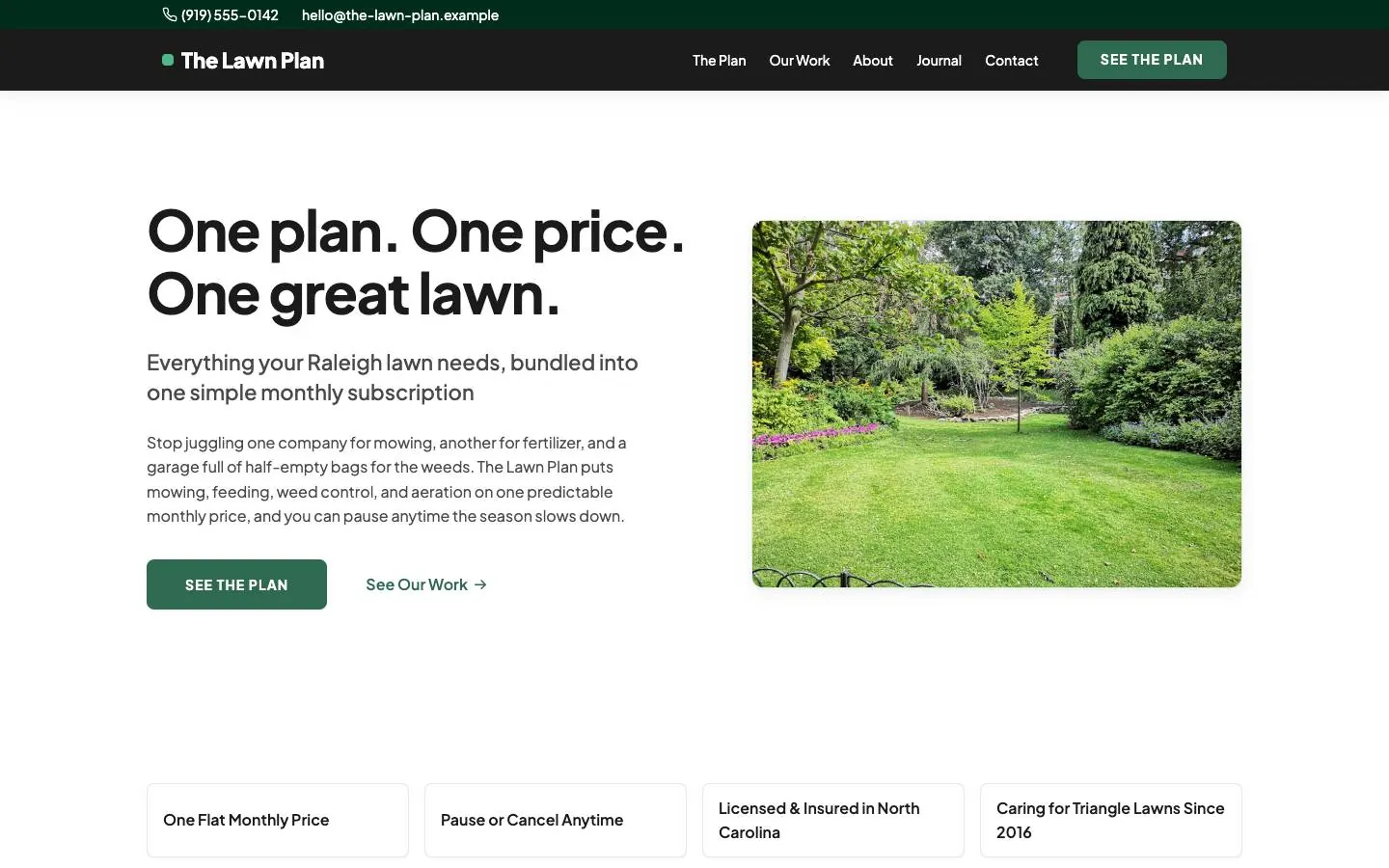
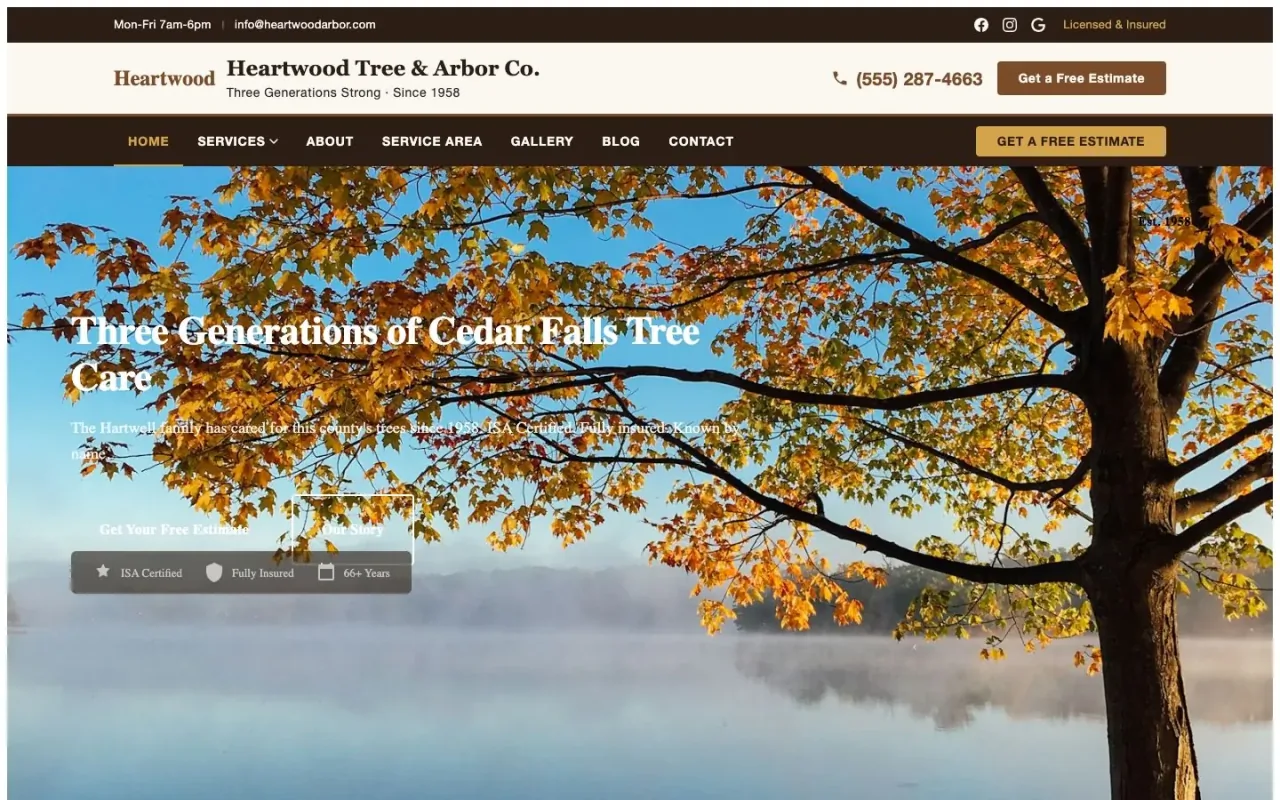
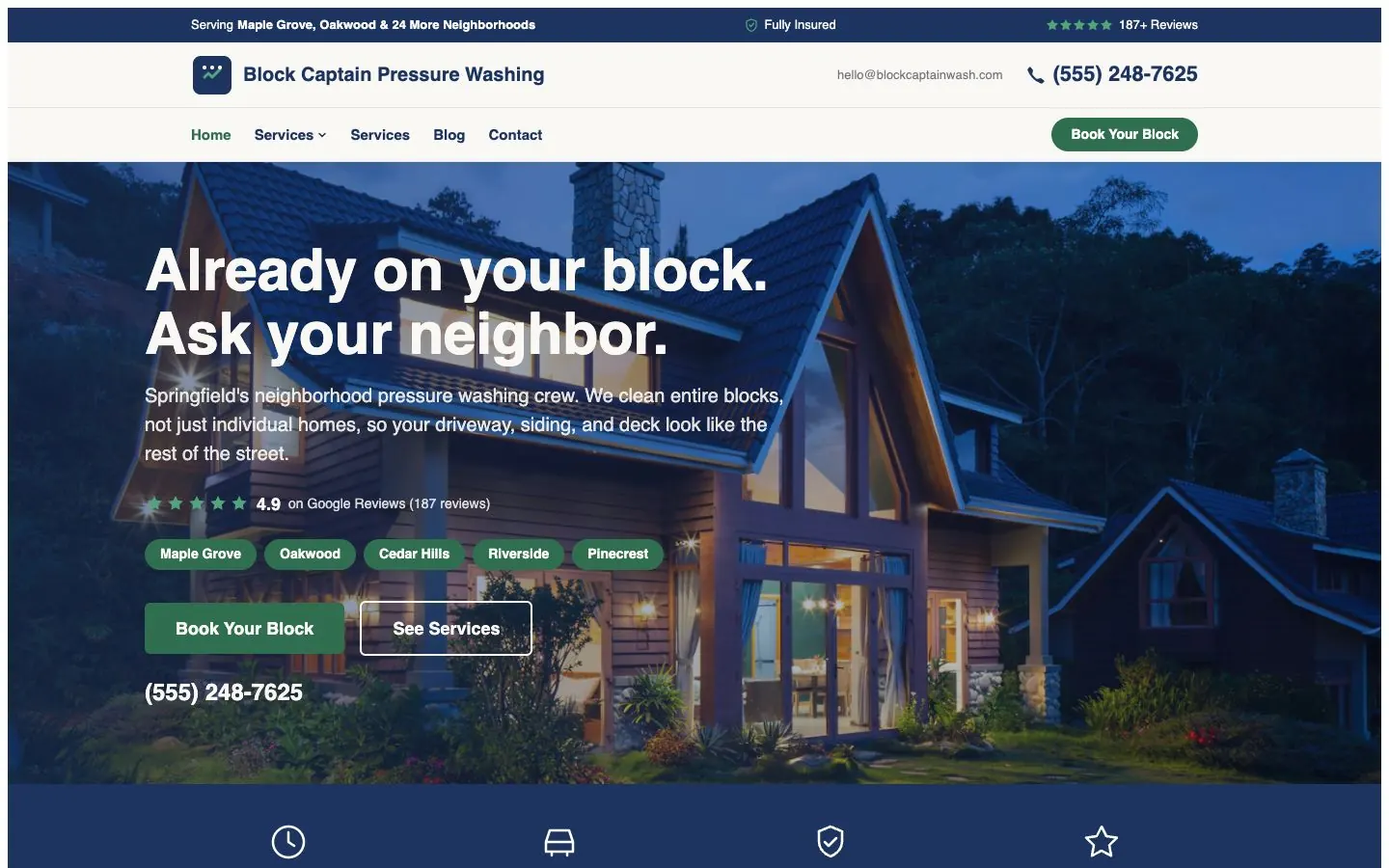
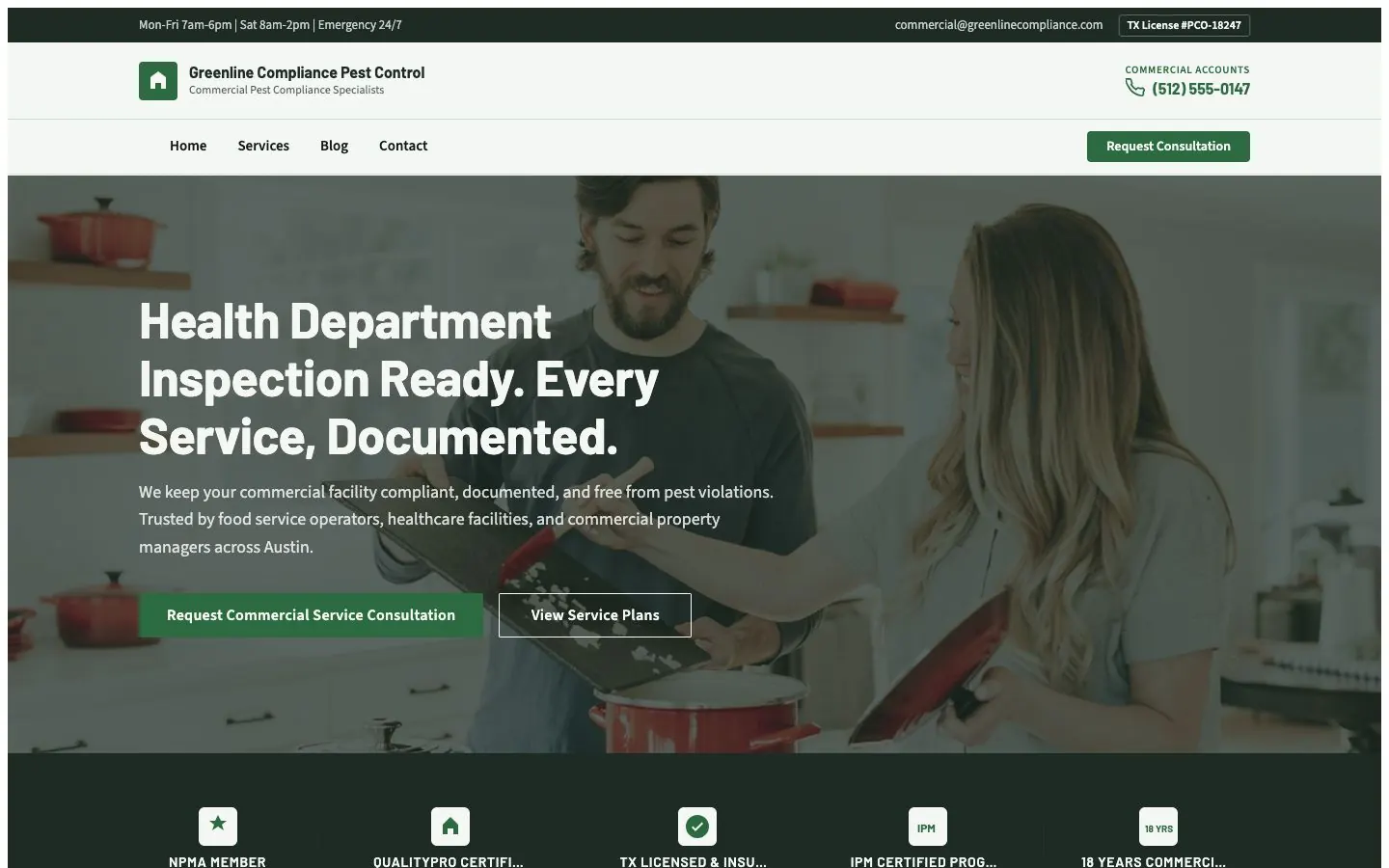
Browse the landscaping designs, tree service designs, pressure washing designs and pest control designs, or see how the website works.
Questions
Do I need a license to spray weeds on a customer's lawn in New Hampshire?
Yes. The Division of Pesticide Control requires a Commercial Applicator license to apply pesticides on anyone else's property, even store-bought ones and even unpaid. Lawn work falls under category G2 Turf Pest Control. Source: the Division of Pesticide Control.
Does everyone on my crew need a pesticide license?
The Division's rule is at least one person with an Operational or Supervisory license on each crew that applies pesticides. Each business or branch office that applies pesticides also needs at least one Supervisory license holder. For your own crew, ask the Division.
Does New Hampshire license landscapers or home contractors?
Not home contractors, according to the Attorney General. In 2022, the office said contractors in New Hampshire don't need a state license. For landscapers, the state licensing office's board list has a board for landscape architects but none for landscape contractors, so ask OPLC about your work. Pesticide work, electrical work and plumbing still need licenses.
Do my New Hampshire invoices need a sales tax line?
Not for state sales tax, because New Hampshire has none. On Locally 360, invoice tax is off by default, so your invoices start with no tax line. We found no official answer on local sales tax, so ask the Department of Revenue Administration's Taxpayer Services.
Do I need to register my business with the Department of Revenue Administration?
Not as a trade business. The Department says new businesses don't register unless they are meals, rooms, vehicle rental, communications or tobacco businesses. Registering is separate from filing: the business tax returns still apply once you're over their thresholds.
How do I register an LLC or a trade name in New Hampshire?
LLCs and corporations register with the Secretary of State's Corporation Division, online through NH QuickStart. They file an annual report by April 1 of each year after the year they register. A sole proprietor registers a trade name only when working under a name other than their own legal name. Trade names renew every 5 years. Source: the Secretary of State's business questions page.
What happens to my site if I cancel?
It stays up until the end of the period you've paid for, with no refund for the rest of it. Then it goes offline. Within 7 days after that, you can ask by email for an export of your content, inquiries, and invoice, payment and booking records. The export is a copy of your data, not a working website, and it leaves out stock images and the design.
Before you sign up
You can count on a site built so Google can find you, every inquiry in your lead inbox and your email, and a short report each month with inquiries against last month, page views and your most viewed pages. No website is perfect, and nobody can honestly tell you what one will bring in. It's month to month with no minimum term, so look at all of it and decide what's right for your business.
Signup is open in every US state, New Hampshire included. It asks for your name, email, phone and business name. Billing starts when you start your plan from the billing page. Here's how signup works.
Questions first? Email support@locally360.app. We reply within three business days.
See service businesses by state.
Sources
Sources checked on November 7, 2026. Each rule above names its agency, with a link beside it. The business counts come from federal data:
- Census County Business Patterns 2023, for landscaping and pest control locations with employees, by size.
- Census Nonemployer Statistics 2023, for landscaping businesses with no employees.
- BLS Quarterly Census of Employment and Wages, landscaping 2025, for the March figure, and the third quarter file, for July.
Not tax or legal advice. For your own situation, ask the agency or an accountant.
Anything else, email support@locally360.app. We reply within three business days.